

Setting Up Your Email - Part 2:
Receiving POP Mail
IMAP Details

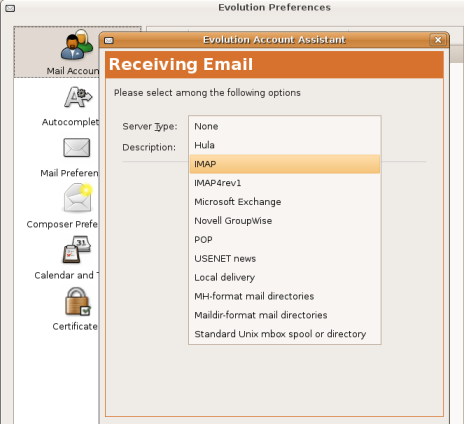
After entering your email ID, select "IMAP" from the list of
e-mail server types. The window will then change to look like this:
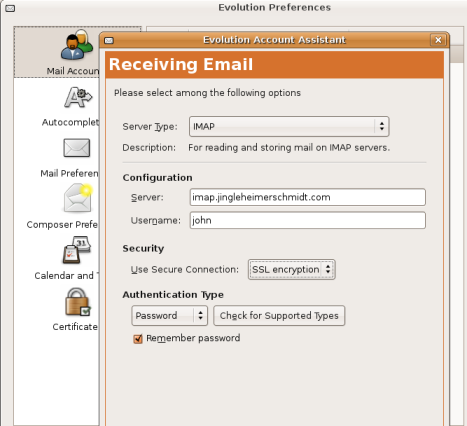
The server is the IMAP server given to you by your mail service
provider. System and network administrators usually name servers
clearly. An IMAP server might have a domain name like
"imap.server.host.com". If this is true for your mail provider, you
can tell the type of server from the first part of the server's
address.
Even if the name does not reveal it, your system administrator should
tell you what kind of server it is. Simply follow their instructions.
If your mail server does not use IMAP, choose a different server type.
In Evolution, click on "Back" and do so. Recall that
the server
types are in the drop down menu.
If you are unsure of the type of mail server your network uses and
cannot tell the type from the address, contact your system
administrator to find out.
The username which Evolution plugs into the username field by default
is imported from the name you gave on the first page. It is lowercase
here because all mail account logins are lowercase by default. If you
use a different login for your email, simply change this field to suit
your needs.
Like most email programs, Evolution retrieves your email without
encryption by default (i.e., using "plain text"). If you need or want
encryption, you must tell it to use TLS or SSL encryption. If your
email service provider has not told you to use encryption, do not try
either form of encryption -- it will only cause a fault in mail
retrieval. Using SSL to access a server that does not support it is
like speaking a foreign language to someone who does not understand
it.
Finally, you can tell Evolution to use a particular type of
authentication. Most of the time, you will only need to use a
password with your username. Other kinds of authentication are
available, however. If you do not know which one to use, simply use
the default: "Password".
If you are confident that the default "Password" will not work and are
unsure of what kind of authentication is supported by the server,
Evolution can check for you. Simply click on "Check for Supported
Types". It will then poll the server to find out what forms of
authentication are available.
If you want Evolution to remember your password and not to ask you for
it everytime it checks for new messages, tick the box next to "Remember
password". Evolution will ask you for the password the first time you
check for messages and will then remember it.
Click "Forward" to enter the options for receiving email.
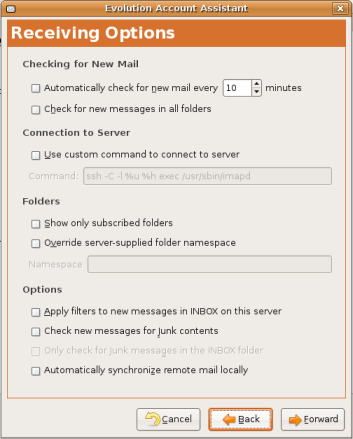
Options for Receiving Email via IMAP

Checking for New Mail
The first option on this window reflects how long Evolution waits
between mail checks. If the box is not ticked, Evolution will not
automatically check for new mail.
Ticking the second box tells Evolution to check all folders for
new mail. This is in case the mail is sorted on the server.
Connection to Server
If you require special options to be set in order to connect to the
server, you can here issue a custom command to connect to the server.
If you do not know what this is, do not worry about it. If you needed
it, your system administrator should have provided it for you.
Folders
The first option is for showing only subscribed folders. If the
address you are checking is used by several people or for several
purposes, you are likely to sort your mail on the server. The mail
then goes into specific subfolders to which you subscribe. Here you
can tell Evolution to ignore the rest.
If you prefer to give your folders names other than those used on the
server, you can set them with the second option.
Options
The first box is to apply your mail filters to new IMAP messages. If
you have mail filters setup, you can have Evolution apply them to new
messages on the server. Note that the filters are only applied to the
IMAP INBOX. It is assumed that the other folders are pre-sorted.
Second, all new messages can be tested for junk contents. Simply tick
the second box.
The third option is for restricting junk mail checking. If you would
like to speed up the time it takes to check for junk mail, you can
restrict such checking to the INBOX.
If you would rather not bother with telling Evolution when to check
mail, you can automate it. Simply tick the last box, and your mail
will be synchronised automatically.
When you are done with these email retrieval options, click "Forward"
to tell
Evolution how you want to send your email.
A Brief History of Linux The Linux kernel is the basic programming foundation for the entire Ubuntu operating system. Here is how it started and why it is called GNU/Linux.
|
Ubuntu's African Roots Ubuntu comes from an African word that suggests humanity and community.
|
Get Ubuntu Linux: Download, Request, or Order Ubuntu Ubuntu can be downloaded or ordered and is available in a couple of versions: 6.06 (Dapper Drake) and 7.04 (Feisty Fawn). Which you use depends on the software you need. This page shows you from where you can download, request, or buy Ubuntu.
|
Ubuntu vs Windows Vista Ubuntu had many Windows Vista features almost a year before Microsoft released it. Here is how Ubuntu compares to Windows Vista.
|
Windows Vista vs Mac OS X Windows Vista looks curiously like Mac OS X. NY Times' David Pogue says there is no connection.
|
How to Install Ubuntu Linux (6.06 LTS) Ubuntu is the easiest Linux version to install. Here is a guide to installing Ubuntu Linux painlessly.
|
Resizing a Windows Installation Resizing a Windows installation is easy with the Ubuntu installer. Installing Ubuntu in parallel to a Windows installation is called 'dual booting' and is a good idea. Here is how to do it.
|
A History of Ubuntu Ubuntu is an African word meaning 'humanity to others.'
|
Adding Ubuntu Software and Other Linux Software to Ubuntu Adding Ubuntu software, non-Ubuntu Linux software, or even proprietary software to your new installation is easy with Synaptic. Here's how.
|
Adding Ubuntu Repositories Adding Ubuntu repositories to download more Linux software is not very complicated. It is a simple matter of telling Ubuntu where to find more software.
|
Additional Ubuntu Repositories Ubuntu software is available in more repositories than the default Ubuntu installation gives you. Here is a listing of more Ubuntu repositories for your software needs.
|
Ubuntu Root Access Ubuntu root access is needed for all system-wide tasks. Here is how to gain root access in Ubuntu.
|
How to Install Ubuntu Linux 7.04 (Feisty Fawn) Ubuntu Feisty was released in April 2007. It is the easiest Ubuntu to install yet. Here is how the installation of Ubuntu Feisty is different from 6.06 LTS.
|
Booting Windows Instead of Ubuntu by Default Grub boots Ubuntu by default. But if you want to make Windows your default operating system without losing Ubuntu, all you need do is change a number in Grub's configuration file. Here is how.
|
Setting Grub Timeout When Dual Booting Ubuntu Grub's menu is hidden by default. Making it visible at startup is a matter of editing grub's configuration file. Here is how.
|
Make Grub's Menu Visible At Startup Grub's menu is hidden by default. Making it visible at startup is a matter of editing grub's configuration file. Here is how.
|
Parts of the Ubuntu Desktop: Top Left Ubuntu uses GNOME as a default desktop. Here are the top left parts of the Ubuntu desktop and what each does.
|
Parts of the Ubuntu Desktop: Top Right Ubuntu uses GNOME as a default desktop. Here are the top right parts of the Ubuntu desktop and what each does.
|
Parts of the Ubuntu Desktop: Bottom Components Ubuntu uses GNOME as a default desktop. Here are the bottom parts of the Ubuntu desktop and what each does.
|
A Primer for Installing Ubuntu Installing Ubuntu should be as easy as possible, and the best guides for this are provided here at Easy Ubuntu Linux. But all the online resources in the world do not help you offline. For this reason, we are providing this PDF primer to help you install Ubuntu.
|
Setup Your E-mail On Ubuntu: Part 1 Sending e-mail under Linux is easy. Here is how to setup your email identity under Ubuntu Linux.
|
Receiving E-mail Sending e-mail under Linux is easy. Here is how to receive email under Ubuntu Linux.
|
Sending E-mail On Ubuntu Sending e-mail under Linux is simple. Here is how to setup Evolution to send email under Ubuntu Linux.
|
Office Suites for Ubuntu Choosing an office suite for your Ubuntu installation is like choosing the first among equals. Here is a comparison of the best office suites available for Ubuntu Linux.
|
Upgrading Ubuntu Ubuntu upgrades are easy to affect. As usual with Ubuntu, you get to choose how to upgrade.
|
Install Ubuntu Upgrades By Updating Your Installation Ubuntu Upgrades are a choice of two straightforward processes. Here is how to upgrade and update all of your programs at once.
|
Affect an Ubuntu Upgrade With An Install CD Ubuntu Upgrades are as easy as the installation. Here is how to upgrade and save your data.
|
Receiving Email via IMAP Sending e-mail under Linux is easy. Here is how to receive email under Ubuntu Linux.
|
Image Handling With Ubuntu Ubuntu's image handling surpasses those of other operating systems. Whether you just need to look at your pictures or create first-rate graphics, Ubuntu offers a program to meet your needs.
|
Photo Previewing and Slideshows With GQView GQView is an additional photo previewing program for Ubuntu. Here is a brief tutorial on how to preview and edit photos with GQView on Ubuntu.
|
Install Ubuntu Install Ubuntu with minimal fuss. Some choices in the installation process are better than others, and this section will help you to install Ubuntu with ease.
|
Configure Ubuntu The default Ubuntu configuration is good for most users. However, you will inevitably want to configure Ubuntu to suit your tastes better.
|
How to Use Ubuntu Once Ubuntu is setup, you may still wonder about how to use Ubuntu. This section will show you how to setup and use software such as email, office suites, and photo editing software.
|
Apache - Ubuntu - Apache Modules on Ubuntu - Part 1 Ubuntu allows webhosting on your computer. Here is how to configure Apache on Ubuntu.
|
Apache - Ubuntu - Apache Modules on Ubuntu - Part 2 Ubuntu lets you run many kinds of servers on your computer. Here is how to configure Apache on Ubuntu.
|
Easy Ubuntu
Linux and the Easy Ubuntu Linux logo ©2006-2007, Integrity
Enterprises.
Ubuntu ©Canonical,
Ltd. All other trademarks and logos are the reserved copyright
possessions of their respective owners.
Unless otherwise stated, all material contained on this website is
copyrighted to Easy Ubuntu Linux.com. All rights are reserved. All
content is provided AS IS without any warranty of any kind for any
purpose.
If you have a question or comment about Ubuntu or this site,
please send email to 'webmaster (at) easy-ubuntu-linux.com' (remove
single quotes and replace "@" for " (at) ").